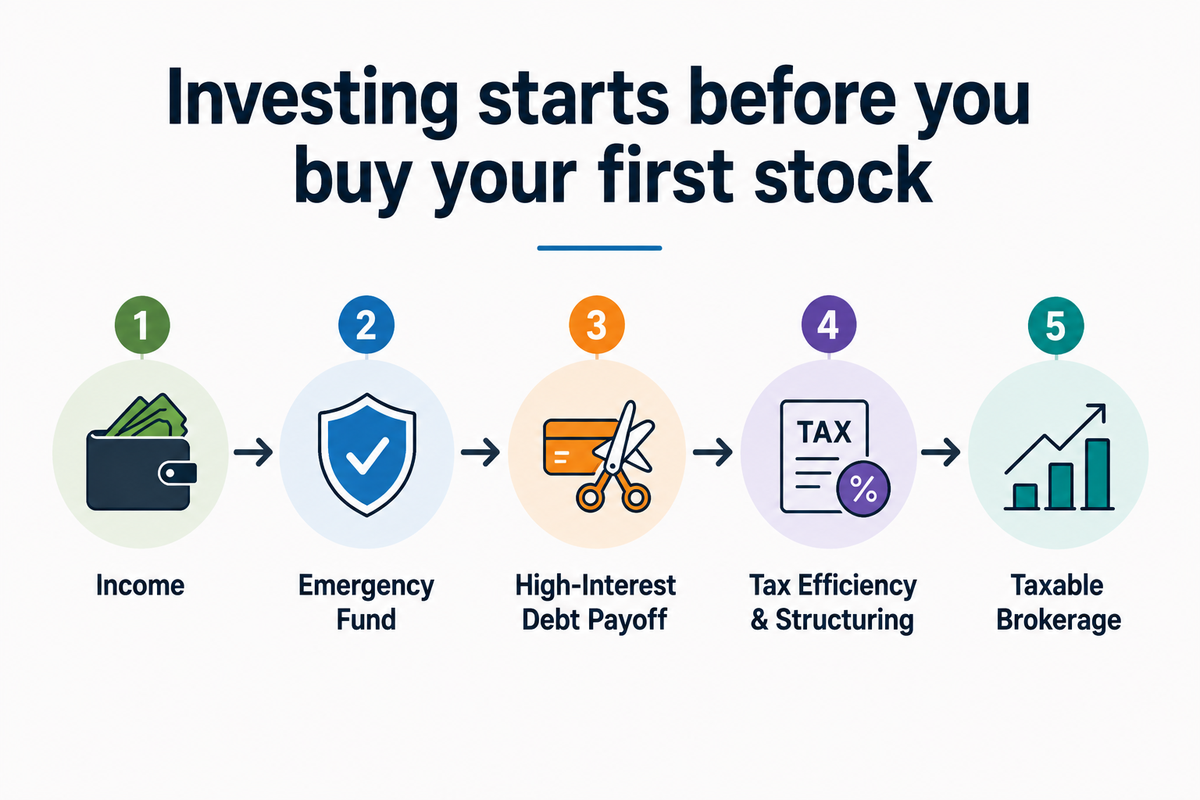
For most retail investors, I think this can be broken down into five main pillars:
📊 1. Income & Cash Flow
This is where everything starts.
The difference between your net income and your living expenses determines how much capital you can actually save and invest.
We spend a lot of time discussing returns, but your savings rate is one of the few variables you can control directly.
💶 2. Capital Preservation & Liquidity
Before putting everything into the market, you need some financial breathing room.
Keeping roughly 3–6 months of essential expenses in liquid cash can prevent an unexpected expense, job change, or other problem from forcing you to sell investments at the worst possible moment.
📈 3. Long-Term Investing
Once expensive debt is under control and an emergency reserve is in place, surplus capital can start working for you.
This is where long-term investing becomes important: protecting purchasing power from inflation and allowing compounding to work over many years.
🛡️ 4. Risk Protection
Investing is not only about maximizing upside.
Insurance, sensible debt levels and basic contingency planning protect the financial system you are building.
A single unexpected event should not be able to undo several years of saving and investing.
🏛️ 5. Tax Efficiency & Structuring
Taxes can have a surprisingly large impact when compounded over decades.
Different European countries offer different structures — PEA accounts in France, ISAs in the UK, and various local equivalents elsewhere.
Some countries(like Bulgaria) offer a 0% capital gains tax rate on profits made from selling stocks, ETFs, and bonds traded on regulated markets within the European Union (EU) and the European Economic Area (EEA).
Understanding what is available where you live can meaningfully improve your long-term net return.
🎯 The priorities also change as life progresses.
Early stage:
Pay off expensive consumer debt, build an emergency fund and start investing regularly into diversified assets.
Expansion stage:
Continue investing, but also plan for medium-term needs such as buying a home, raising a family or making larger purchases. Money you may need soon generally shouldn't depend on what the stock market does next year.
Pre-retirement:
The focus gradually changes from accumulation toward managing volatility, sequence-of-returns risk and eventually creating a sustainable withdrawal strategy.
The main point is simple:
A strong investment portfolio cannot compensate for weak cash-flow management or a lack of liquidity.
Build the financial system first.
Investing becomes much easier when you are not depending on your portfolio to solve every short-term financial problem.